
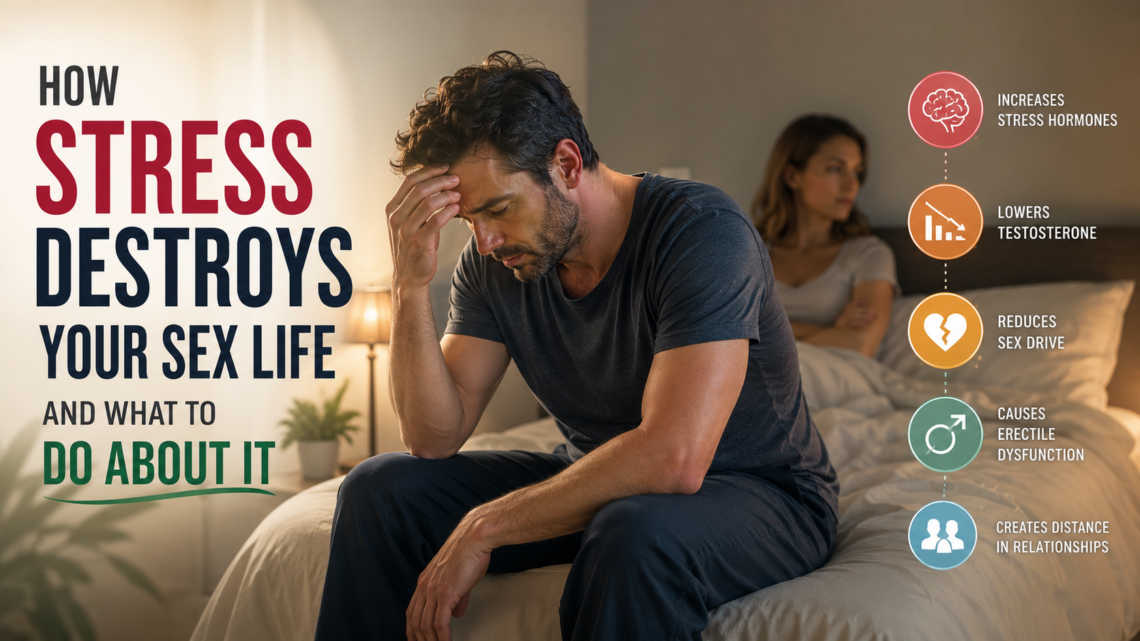
How Stress Destroys Your Sex Life and What to Do About It
June 4, 2026You had a rough week at work. Bills are piling up. Sleep has been terrible. And now when you finally have a moment to be intimate with your partner nothing happens the way it should.
Sound familiar?
Most men never connect the dots between the stress they carry every day and the problems they experience in the bedroom. But the connection is very real and very direct. Stress does not just affect your mood or your sleep. It goes deep into your hormones your blood vessels and your nervous system and quietly shuts down the systems your body needs for a healthy sex life.
This guide explains exactly how that happens and more importantly what you can do about it.
What Stress Actually Does to Your Body
Before we talk about sex it helps to understand what stress actually is from a biological standpoint.
When your brain senses a threat it triggers something called the fight or flight response. Your body releases cortisol and adrenaline. Your heart rate goes up. Blood gets redirected to your muscles and away from organs your body considers nonessential in a crisis including your reproductive system.
This response was designed for short bursts of danger. The problem is that modern life keeps that stress switch stuck in the on position. Work pressure, financial worry relationship conflict and poor sleep all keep cortisol levels elevated day after day.
When cortisol stays high over a long period of time it starts interfering with nearly every system in the body that matters for sexual health.
How Stress Kills Your Sex Drive
One of the first things men notice when they are chronically stressed is that their desire for sex quietly fades. This is not a coincidence.
Cortisol and testosterone have an inverse relationship. When cortisol goes up testosterone goes down. Since testosterone is the primary hormone behind male sex drive a prolonged drop in it means a prolonged drop in the desire to have sex at all.
Many men assume this is just aging or that they are simply not in the mood. But in a large number of cases it is unmanaged stress steadily eroding testosterone levels in the background.
If you have noticed your interest in sex has decreased alongside a period of high stress in your life the two are almost certainly connected. You can learn more about the direct link between testosterone and sexual health in this guide to how testosterone affects men’s overall health.
Stress and Erectile Dysfunction
This is where the impact of stress becomes most obvious for many men. Stress is one of the leading causes of erectile dysfunction especially in younger men.
Getting an erection requires the nervous system to send the right signals blood vessels to relax and adequate blood flow to reach the penis. Stress disrupts all three of these steps at the same time.
The fight or flight response keeps the nervous system in a state of high alert. In that state the body does not prioritize sexual function. Blood vessels stay constricted rather than relaxed. And the hormonal environment works against arousal rather than supporting it.
For men who are already dealing with performance anxiety the problem compounds itself. You feel stressed about work. That stress makes it harder to get an erection. You then feel anxious about not being able to perform. That anxiety creates more cortisol. And the cycle continues. Many men end up in this loop without realizing that the original trigger was not sexual at all it was just stress.
This kind of psychological ED is extremely common. If this sounds like your experience reading how to overcome anxiety about sexual performance may help you understand what is going on.
The Sleep Connection
Stress and poor sleep go hand in hand and both of them devastate sexual health.
Testosterone is produced primarily during deep sleep. Men who are stressed sleep poorly. Men who sleep poorly produce less testosterone. Less testosterone means lower libido and weaker erections.
Research consistently shows that even a week of getting less than five or six hours of sleep per night causes testosterone levels to drop significantly in healthy young men. That is not a minor drop. Studies show it can reduce testosterone by up to 15 percent which is enough to noticeably affect sex drive and performance.
If you are lying awake at night running through tomorrow’s problems your body is being robbed of the hormonal recovery it needs to support a healthy sex life.
Stress Affects Your Relationship Too
Sexual health does not exist in isolation. It is deeply tied to how connected you feel with your partner.
Chronic stress makes men more irritable, less communicative and emotionally withdrawn. When emotional distance builds between partners it almost always shows up in the bedroom. Intimacy requires a sense of safety and connection. Stress erodes both.
Men who are stressed often pull away without meaning to. Partners interpret that withdrawal as rejection. Tension builds. And the bedroom becomes another source of stress rather than a place of comfort.
Understanding this dynamic is important because solving the sexual problem often means addressing the relationship first. Open honest communication about what you are going through is not a weakness. It is one of the most effective things you can do.
What You Can Do About It
The good news is that stress related sexual problems are highly reversible. You do not need to accept them as permanent. Here are the approaches that actually work.
Reduce the Source of Stress Where You Can
This sounds obvious but it is worth saying. Identify the biggest sources of chronic stress in your life and take concrete steps to reduce them. That might mean setting boundaries at work, having a difficult financial conversation or addressing relationship tension directly.
Not all stress can be eliminated but removing even one major source makes a measurable difference in cortisol levels and how you feel physically.
Exercise Consistently
Regular physical activity is one of the most powerful tools available for managing stress and improving sexual health at the same time. Exercise reduces cortisol. It boosts testosterone. It improves circulation and blood flow. And it builds the confidence that stress tends to erode.
Even 30 minutes of moderate exercise five days a week produces significant improvements in mood energy and sexual function over time.
Prioritize Sleep
Protecting your sleep is not a luxury. It is one of the most direct things you can do for your hormonal health and your sex life. Set a consistent bedtime. Limit screens before sleep. Keep your bedroom cool and dark. If stress is keeping you awake techniques like progressive muscle relaxation or guided breathing can help quiet the nervous system before bed.
Talk to Someone
Whether that is your partner, a trusted friend or a therapist getting your stress out of your head and into the open reduces its physical impact on your body. Cognitive behavioral therapy has strong evidence behind it for both stress management and sexual performance issues.
Consider Medical Support
For men whose sexual function has been significantly affected by stress medical support can play an important role while lifestyle changes take effect.
Generic Viagra containing Sildenafil 100mg helps improve blood flow and erection quality. For men dealing with performance anxiety it provides reliable physical support which in turn reduces the mental pressure that feeds the cycle of stress related ED.
For men who want more flexibility Vidalista 20mg Tadalafil remains effective for up to 36 hours. This longer window removes the pressure of timing which itself is a significant source of anxiety for stressed men. The less you are thinking about whether the medication will work in time the more relaxed you feel and relaxation is exactly what your body needs.
Men who experience both ED and premature ejaculation alongside chronic stress may find that Super Vilitra offers the most comprehensive support. It combines Vardenafil for erection quality and Dapoxetine for ejaculation control in a single tablet making it a practical option when stress has affected multiple aspects of sexual health at once.
It is important to speak with a healthcare provider before starting any medication. These options work best as part of a broader plan that also addresses the stress itself.
Key Takeaways
Chronic stress raises cortisol which directly lowers testosterone and reduces sex drive.
Stress triggers the fight or flight response which constricts blood vessels and makes erections difficult.
Poor sleep caused by stress further reduces testosterone production overnight.
Performance anxiety created by stress-related ED feeds a cycle that makes the problem worse over time.
Lifestyle changes including exercise, better sleep and stress reduction are the most effective long term solution.
Medical support from medications like Sildenafil and Tadalafil can help break the cycle while lifestyle changes take effect.
Frequently Asked Questions
Q1: Can stress alone cause erectile dysfunction?
Yes. Stress is one of the most common causes of erectile dysfunction especially in men under 40. It disrupts the hormonal environment, constricts blood vessels and keeps the nervous system in a state that works against sexual arousal.
Q2: How long does it take for stress-related ED to improve?
It depends on how long the stress has been present and how actively it is being addressed. Men who make consistent lifestyle changes often notice improvement within four to eight weeks. For some the improvement is faster especially when the source of stress is removed.
Q3: Does Viagra help with stress related ED?
Sildenafil can be helpful for stress related ED because it supports the physical mechanism of erection. This gives a man more confidence which reduces performance anxiety. However it works best alongside efforts to manage the underlying stress rather than as a standalone solution.
Q4: Can stress permanently damage your sex life?
In most cases no. Stress-related sexual problems are highly reversible. The body responds well to reduced stress improved sleep and regular exercise. Long term untreated stress can cause more lasting hormonal changes but even these are typically addressable with the right support.
Q5: Is it normal to lose interest in sex when stressed?
Completely normal. Reduced libido during periods of high stress is a direct biological response to elevated cortisol and lowered testosterone. It does not mean anything is permanently wrong. It is your body telling you that something needs to change.
Medical References
- Mayo Clinic. Stress Symptoms: Effects on Your Body and Behavior. View Source
- NHS. Erectile Dysfunction Causes. View Source
- Cleveland Clinic. Stress and Erectile Dysfunction. View Source
- WebMD. How Stress Affects Your Sex Drive. View Source
- Harvard Health Publishing. Testosterone and Men’s Health. View Source